Sunday, January 12, 2014

Spectral profiles and calibration

Example profiles and calibration for Beta and Gamma Cassiopeiae using RSpec and custom Python script. 


http://www.rspec-astro.com/
https://code.google.com/p/atgc-spectra/

Wednesday, January 8, 2014

Stars with absorption and emission hydrogen lines in their spectra

Beta and Gamma Cassiopeiae spectra taken through Rainbow Optics Star Spectroscope grating filter 200 lines/mm. Gamma Cassiopeiae displays distinct spectrum with hydrogen emission lines specific for B(e) type stars.


http://en.wikipedia.org/wiki/Beta_Cassiopeiae
http://en.wikipedia.org/wiki/Gamma_Cassiopeiae
http://en.wikipedia.org/wiki/Be_star

Orion Nebula spectral composition

Orion Nebula through SA100 Star Analyzer:

Orion Nebula through RO200 Star Spectroscope:

Detection of B(e) star:

http://en.wikipedia.org/wiki/Orion_Nebula
http://en.wikipedia.org/wiki/Be_star

Distinct spectrum of Rho Persei

Mirfak, Algol and Gorgonea Tertia spectra through Paton Hawksley Star Analyzer grating filter 100 lines/mm


Rho Persei is a semiregular variable star of the μ Cephei type, whose apparent magnitude varies between 3.3 and 4.0 with periods of 50, 120 and 250 days. The star has reached the asymptotic giant branch of its evolution. It is near the tip of the red giant branch with a stellar classification of M4 II. The outer envelope has an effective temperature of 4,111 K, giving it the red-orange hue of an M-type star.

http://en.wikipedia.org/wiki/Alpha_Persei
http://en.wikipedia.org/wiki/Algol
http://en.wikipedia.org/wiki/Rho_Persei

Tuesday, December 24, 2013

Orion star trails through spectroscope

Orion star trails through diffraction filter SA100. Spectrum of hot Rigel is different form colder Betelgeuse. Spectrum of M42 Orion Nebula is distinct from contiguous patterns of star spectra. See more about astronomical spectroscopy and stellar classification at http://en.wikipedia.org/wiki/Astronomical_spectroscopy and http://en.wikipedia.org/wiki/Stellar_classification

A - single shot; B - composition of 46 images; Lumix LX3 - SA100 diffraction filter - 60mm lens - ISO400 - f/2.8 - 25 seconds.


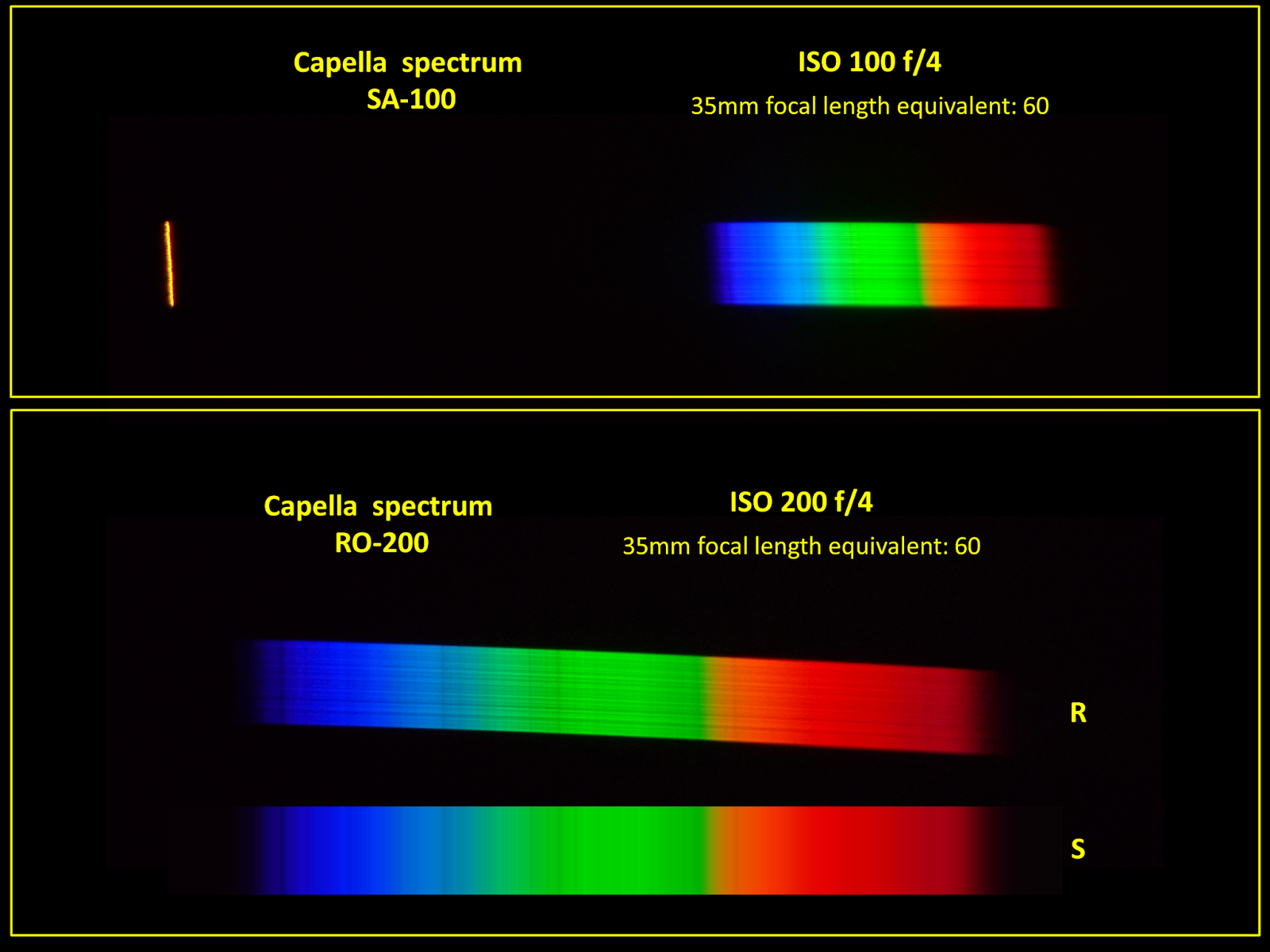
Diffraction grating filters: SA-100 vs RO-200

Rainbow Optics RO-200 provides more details in star spectra, more absorption lines are visible/detectable. Star Analyzer SA-100 is better for faint stars since generated spectrum is narrow. 

Examples of spectra for three bright stars (Capella, Menkalinan and Al Kab).

Afocal stellar spectroscopy setup

Afocal stellar spectroscopy with RO-200 and SA-100 grating filters, Celestron XLT 150 Newton telescope, and Lumix LX3 camera

Afocal setup with Lumix-LX3, extension adapters and Plossl 25mm:

Diffraction grating filters (RO-200 or SA-100) are attached to afocal setup through a set of eyepiece extension rings. Disassembled Barlow unit is used as major extension adapter:

Completely assembled unit (spectroscope grating filter + extension rings + Plossl 25 + camera adapter + photo camera) is inserted into telescope focuser (Celestron XLT 150 Newton). Barlow barrel allows to rotate grating filters independently from camera to adjust appropriate spectrum direction for drift style photography:

Examples of stellar spectra through SA-100 (Aldebaran and Castor):

Examples of stellar spectra through RO-200 (Vega, Sirius and Betelgeuse):

Aldebaran spectrum SA-100 vs RO-200:

Capella spectrum SA-100 vs RO-200:

Pleiades through SA-100: